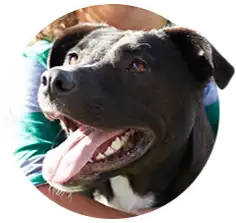
Bonnie's Big Break
A retired California couple discovers the high cost of fixing a damaged dog
William Childress
In
June 2002 at the Sacramento SPCA, my wife Diane and I adopted a damaged dog.
Her right front leg had been crushed, presumably by a car; untreated, it had
healed awkwardly, and now resembled a seal's flipper. Even so, the dog
danced around like a flea on a hot plate. Her cage card said her name was Bonnie,
and it classified her as very loving (true) and very active (true!).
Bonnie
was a stray. No one knew when she'd been born, or how long she had run
wild, but SPCA officials set her age at a year and a half. With her twisted
foot, she was unlikely to be adopted, and her future was cloudy. Scars on her
forehead indicated she'd been attacked by other dogs, probably several
times. After we'd had her a few weeks, Diane and I realized that her
experiences had made her "dog aggressive," a behavioral condition
we would eventually have to deal with.
Why
take such a dog home?
My
first impulse is to say that my wife is so nuts about animals, she'd
adopt a wolverine. But Bonnie's salesmanship also played a role. Her
pitch would have impressed a carnival barker. She stood on her hind legs, yipped,
spun around, and leaped against the mesh of her pen. She pulled out all the
stops, barking and displaying her amazingly long tongue.
"Let
me lick you!" she yelped. "You'll take me home then!"
With
every stunt, my wife melted further. Soon she was crooning like a new mother.
The cunning canine promptly lay down and rolled over - a trick she hasn't
performed since. Finally, when the SPCA volunteer took her into the get-acquainted
room, she showed the depth of her gratitude by making a puddle on the floor.
"I
want this dog," my wife said firmly. There was no consultation. The smart
husband will recognize when one isn't necessary.
In
the Eye of the Beholder...
Bonnie
was a beautiful dog by any standard, but she could have been the Hunchback of
Kennel Three and my wife would have taken her. Tan, with orange highlights and
creamy patches on her chest and rump, she had golden-brown eyes and long, pointed
ears. At a muscular 55 pounds, Bonnie reminded us of a dingo. Dingos, however,
have received bad press, so we started telling everyone she was an ibizan hound.
That both puzzled and impressed them, since ibizans are rare in our neck of
the woods. (A veterinarian would later suggest she was a shepherd mix.)
When
we adopted Bonnie, Mike Winters, the executive director of the Sacramento SPCA - who
for 20 years has helped grow the organization into the modern, 30,000-square-foot
facility it now is - made a decision from the heart. Looking at her twisted
foot, he said, "If you decide to rehabilitate Bonnie, maybe we can help
a little." (I learned later that there was no fund for this purpose.)
We
told Winters we'd contact him after an orthopedist examined our bouncing
bowser. Two days later, we were at Sacramento Veterinary Surgical Services,
one of only three facilities for specialized veterinary surgical procedures
in the Sacramento Valley.
Dr.
D.W. Griffin would perform the initial exam and later, the surgery. Bonnie would
be sedated for the exam, so we returned the next morning, when Dr. Griffin took
X rays of both legs. He would use the good leg as a pattern. As we studied the
films, it was obvious that Bonnie had a big problem. Running wild on her crushed
foot, she had totally distorted the bones and muscles. We wondered how she had
survived, especially when running from other dogs.
Tough
Choices
"This
is an interesting case..." Dr. Griffin began.
Ka-ching!
"Not
a terribly rare case, but one that will require special procedures and a lot
of patience if we are to return her leg to some semblance of normalcy."
Ka-ching!
"Can
she be cured?" my wife asked, clearly not hearing the same sound effects
that I was. "That's
all that matters."
She
shot me a glance that said, Be afraid, be very afraid.
As
if I would interfere with a mother and her child.
"We
can improve her condition," responded Dr. Griffin. "But at best,
corrective osteotomy rarely restores more than 80 percent of the original mobility.
There'll also be scars, and the curative process is lengthy - as
much as five or six months." He paused, obviously reluctant to mention
another possibility.
"You
could also consider amputation. Dogs do quite well on three legs. And to be
frank, the prognosis for corrective osteotomies is guarded."
"No
amputation," my wife said firmly. "Only if nothing else works."
That
night, Diane and I dug up the coffee can in the backyard, counted the contents
and summed it all up with, "Bank loan!"
Some
folks might think I had a blithe attitude toward our dog's problem, but
Bonnie herself is blithe. In fact she's the soul of good cheer, whose
constant clowning and zany behavior helped us all through months of waiting
(for us) and pain (for her).
Under
the Knife
We
opted for surgery, and Dr. Griffin assembled his team. In addition to himself
were Dr. Jennifer Arnold, Dr. Steven Tarver and surgical technician/anesthetist
Danielle Carey.
"The
original trauma produced a growth plate deformity," Dr. Griffin explained.
"Bonnie's wrist stopped growing normally, is bent 90 degrees to
the side, and her foot is nonfunctional. To attempt realignment, we can use
a bone plate and screws, or an external skeletal fixator."
Bone
plates are the time-honored method, and Dr. Griffin (who called Bonnie "The
Maniac") felt they might work best, given her energy level. Carey administered
anesthesia, and Doctors Griffin, Tarver and Arnold began the task of incising
skin and tissues to expose the bones and tendons of the foreleg.
A
drastic rotation would be necessary to overcome months of damage as Bonnie ran
on the side of her foot. Dr. Griffin cut tiny wedges of bone from the radius
and the ulna, ground them up, and after aligning the bones, sprinkled the bone
dust back into the wound so the nutrients could be absorbed. Then he screwed
on the plate and closed the incision.
Bonnie
would face high pain levels. Following surgery, she was put on morphine for
two days. When the worst pain was past, she wore a Fentanyl® patch for slow,
regular administration of the analgesic. Acepromazine, a sedative, was given
"as needed" in an attempt to control Bonnie's exuberant behavior and
keep the bones from destabilizing. We made good use of the "ace."
But
four weeks later, Bonnie was back in the hospital.
"The
plates won't work for such an active dog," said Dr. Griffin. "Now
we'll try the external fixator, which hindsight tells me may have been
a better first choice."
Our
banker was a nice man who liked Bonnie, but we figured one stiff loan was his
limit. Meanwhile, true to his word, Mike Winters of the Sacramento SPCA sent
his contribution. But with $2,700 already invested, we were facing an eventual
price tag of $5,000 or more, just to fix a leg. We're folks who save
coupons and are happy for theater discounts, so we said, sadly, that we just
couldn't do it.
Dr.
Griffin smiled. "Actually, we were thinking of making Bonnie a project.
Her condition is unusual enough to serve as a learning aid for interns, and
the hospital would pay expenses, if you're willing."
Willing?
If
Bonnie hadn't been spayed, I'd give him a pup! In fact, I'd give him several!
Under
the Knife Again
The
fixator is external, not screw-plated to the bone, so it's much stronger.
Stainless steel pins are screwed through the fractures to stabilize them, then
anchored to the fixator and tightened or loosened with a tiny wrench.
Because
the pins stick out and snag things, a bun-shaped bandage is wound around the
device. External fixators are used to stabilize fractures and immobilize joints,
and consist of three units: transfixion pins for holding large bone fragments,
external connectors to support fractures and linkage devices to attach and hold
pins and connectors in place.
Even
when wearing a cast, which she did for months, Bonnie's energy was phenomenal
and her strength astonishing. She would leap high into the air with her powerful
hind legs, trusting us to catch her before she crashed down on the injured leg.
I called her Supermutt and threatened to put a cape on her.
During
this period, exercise was vital. It strengthened the muscles and made the bones
knit more quickly. Far from objecting, Bonnie hobbled along briskly, her leg
clunking like Long John Silver's. By the time the cast was changed each
week, the old one was a wreck.
Before
long, Bonnie's "dog aggressiveness" returned. She would
see a dog and go berserk. Yipping, barking and snarling, she hurled herself
against her leash. But if she got too near and the defender growled, Bonnie
groveled and urinated. My wife, the self-appointed walker of our kangaroo, finally
agreed to let me share in the delights of arms nearly dislocated by 55 pounds
of leaping dogflesh.
The
cast and her pain made it impractical to take Bonnie for obedience training,
so we tried books and treats. No luck. Obviously, Bonnie's early life
had made an indelible imprint on her that only professional trainers could ameliorate - more
costs that we hadn't figured on.
Surgery
Number Three
Our
spirits sank in early November when Dr. Griffin announced that Bonnie's
chances for a good, usable right front leg weren't great. We might not
reach the 80 percent improvement level after all.
Despite
all she'd been through, it seemed unlikely now that Bonnie's new
ankle joint would support her. Thus the team operated a third and - Diane
and I vowed - final time. Abandoning the hope of a flexible new joint,
Dr. Griffin turned to arthrodesis, a procedure whereby a stainless steel plate
was implanted inside the leg to permanently "fix" the joint. Attached
to the bones with 10 stainless steel screws, the implant, which may either remain
in place forever or eventually be removed, will allow the joint to fuse. So
although Bonnie's wrist would be stiff, the doctors felt she'd
be able to walk and even run on it successfully. Once again Bonnie was in a
cast. "She still has a ways to go," Dr. Griffin said. "It'll
be Christmas before we can free her from casts and splints entirely."
Bonnie
would not leave the cast alone. Either from discomfort, anxiety or both, she
chewed on it constantly. Dr. Griffin prescribed an "Elizabethan collar"
and instructed that Bonnie was to wear it day and night. But after a few days
of watching her darling dog struggle to maneuver in the clumsy headpiece, my
wife could bear no more. "I trust Bonnie," she declared, clearly
implying that my faith was a small, pathetic thing in comparison, and she removed
the collar. Bonnie immediately set on the cast again, chewing at it and licking
her wound until soon enough she'd developed a nasty infection. A course
of antibiotics was begun, with weekly visits to remove the cast, cleanse the
wound, inspect the site for healing and the leg for stability. On December 18,
after a week or two of slow progress, we finally heard some good news. The bones
were knitting, Dr. Griffin felt the infection would pass, and the date of January
3 was set for removal of the cast. For the first time in nearly seven months,
Bonnie would be allowed to walk with nothing on her right front leg. Short of
gangrene, we hope to be done with vets, clinics, casts and all at that point.
We've already planned a 1,200-mile road trip in mid-January - with
Bonnie, of course.
Reflections
Bonnie's
inconvenience has also been ours. We've been her prisoners, because she
couldn't go anywhere. Our vacation plans were cancelled or modified.
The price tag has surpassed $5,000. Once a week, and sometimes more often, we
made the 50-mile round trip drive to the clinic, putting roughly 1,400 miles
on our car. By the time Bonnie is reasonably mobile, we'll have devoted
seven months of our life to one front leg.
If
we had it to do over, would we do it again?
Absolutely.
This
goofy, frenetic dog has brought us joy, laughter and love. As my wife says,
"She completes our family." Besides, we both fell in love with
her and her shenanigans at the Sacramento SPCA.
Our
children are grown and gone, so Bonnie is simply a new challenge. As for Dr.
David Griffin and his team, they did a superb job with a difficult, long-neglected
problem. We hope they've learned enough from Bonnie's ordeal so that the interns
can help other dogs with orthopedic problems.
William Childress is retired from the St. Louis Post-Dispatch, where his
column received two Pulitzer Prize nominations. A widely published writer/photographer,
he's also a poet and the author of five books, including An Ozark Odyssey (forthcoming
from So. Illinois Press). He lives near Sacramento with his wife, Diane, and
rebuilt dog, Bonnie.
© 2003 ASPCA
ASPCA Animal Watch - Spring 2003